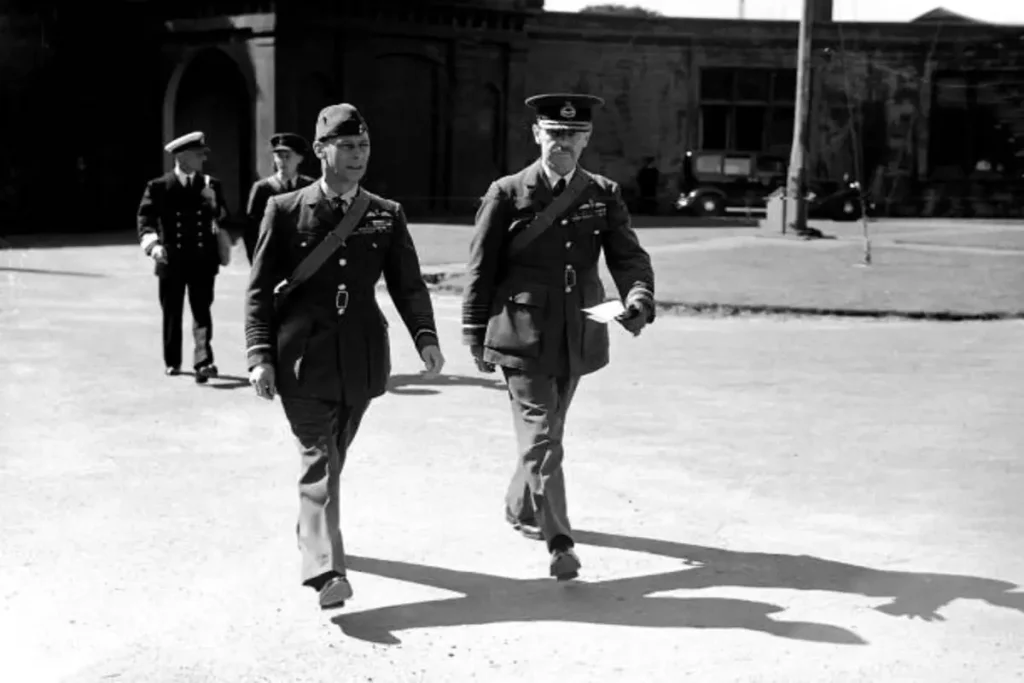
King George VI in RAF uniform walks with Air Marshal Hugh Dowding, commander during Britain’s 1940 air defense, September 1939.Popperfoto via Getty Images/Getty Images
The answer involves a blend of official British neutrality, logistical realities, and diplomatic strategy—all of which impacted the Jewish Yishuv’s access to arms at a critical time.
The Official Embargo Policy and Its Rationale
In early 1948, facing mounting unrest and preparing to evacuate its forces, the British government implemented a sweeping arms embargo on Palestine. The embargo barred the sale or transfer of any “material of military value” to private groups within the territory.
This policy was, on paper, neutral. It applied equally to Jewish and Arab factions and was enforced under the claim of preventing further bloodshed in the final months of British rule.
In a March 1, 1948, parliamentary debate, British officials reaffirmed their position. They insisted that both Jewish and Arab groups were to be denied access to weapons and military equipment.
The stated goal was to de-escalate violence during Britain’s exit and avoid becoming entangled in the inevitable war expected to follow their departure.
However, critics of the policy—then and now—argue that neutrality in language did not translate to neutrality in effect. While Arab states had formal military ties with Britain, the Jewish population in Palestine had no comparable channels.
This made the arms embargo significantly more restrictive for the Yishuv and its main defense force, the Haganah.
Strategic Consequences for the Jewish Yishuv
The Jewish leadership understood early on that a military confrontation with Arab forces was inevitable. But Britain’s arms embargo meant that the Yishuv had to turn to alternative methods to secure weaponry.
Deprived of official supply routes, they engaged in one of the most extensive underground arms procurement operations of the era.
Key to this effort was an agreement with Czechoslovakia in early 1948. Through a series of covert flights and shipping operations known as Operation Balak, the Jewish leadership secured thousands of rifles, machine guns, mortars, and even fighter aircraft.
These weapons, flown in via Yugoslavia and other Eastern Bloc routes, were instrumental in arming the Jewish forces before the declaration of independence in May 1948.
At the same time, the Yishuv expanded its domestic arms production. Improvised munitions factories and clandestine workshops produced grenades, Sten guns, and armored vehicles.
The Jewish defense network also salvaged abandoned British supplies and engaged in smuggling weapons through European ports, often using repurposed ships from the illegal immigration effort known as Aliyah Bet.
Arab Access to Arms and British Diplomacy
While Jewish groups scrambled to build a wartime supply chain, the Arab states surrounding Palestine—Egypt, Transjordan, Syria, Lebanon, and Iraq—maintained direct or indirect military support relationships with Britain.
Although Britain formally adhered to the arms embargo for all private buyers, it did not completely halt military assistance to recognized Arab governments. As a result, Arab states were better positioned to obtain conventional arms through established supply lines.
This dynamic led many Jewish officials and international observers to accuse Britain of veiled favoritism. They contended that, while appearing evenhanded, Britain’s embargo created a de facto disadvantage for the Jews, who lacked a state or formal military contracts.
Some British officials tacitly admitted that arms supplies to Arab states—especially Transjordan’s Arab Legion—were maintained under existing defense agreements, even as Jewish forces remained isolated from comparable support.
Indeed, as parliamentary records show, British lawmakers debated whether the continued arming of Transjordan constituted a breach of neutrality.
Despite concerns, most of the support to the Arab Legion continued under the terms of earlier treaties, with British officers like Glubb Pasha commanding Jordanian forces well into the 1948 war.
Was the Embargo Effective?
Though strictly enforced in British-controlled zones, the embargo was far from airtight. Jewish intelligence operations often outmaneuvered British efforts, particularly at European ports and airfields.
By the time Israel declared independence, the Jewish military—soon reorganized into the Israel Defense Forces (IDF)—had acquired a critical mass of weaponry.
Yet this success came at high cost. Delays in arms delivery, combined with limited training time for new recruits, meant that early battles of the 1948 war were fought under serious constraints.
In Jerusalem and Galilee, for example, Jewish forces often used outdated or homemade weapons until Czech shipments arrived in larger quantities by late May and early June.
Meanwhile, Arab militias and regular armies entered Palestine with better coordination and conventional firepower.
Assessing British Intentions and Legacy
Britain’s embargo was shaped by a complex set of motivations: a desire to end its imperial entanglement, domestic pressure to minimize further military casualties, and geopolitical positioning in the Middle East. Though presented as an impartial policy, the embargo’s impact tells a more complicated story.
Jewish leaders and many historians have long argued that the embargo placed the Yishuv at an unfair disadvantage, forcing it to take extraordinary measures to ensure survival.
Arab access to state-sponsored weapons, combined with Britain’s failure to enforce embargo conditions uniformly, further fed the perception of bias. Yet Britain’s stance also reflected real concerns about escalating the conflict and undermining future relations with Arab states.
At the time of the Mandate’s final days, the British monarchy was headed by King George VI and Queen Elizabeth. While they did not play a direct role in shaping colonial policy, the monarchy embodied the British Empire’s authority and stability. King George VI’s reign spanned the Second World War and the start of Britain’s global decolonization.
The royal family’s symbolic role in Palestine reflected a fading imperial order, with Queen Elizabeth, later known as the Queen Mother, representing continuity amid retreat. Their reign quietly witnessed one of the most consequential withdrawals in British imperial history.
Conclusion
Yes—Britain did impose an arms embargo at the end of the Mandate, applying it to both Jewish and Arab actors. But the embargo’s real-world effect was far from balanced.
For the Jews of Palestine, it created a dire challenge that required creativity, speed, and international support to overcome.
Also Read: Over 60,000 killed in Gaza since start of Israel-Hamas war, Gaza health ministry says
The fact that Israel emerged from that period with an operational army and declared statehood is not a testament to British policy—it is a testament to Jewish resilience in the face of logistical and diplomatic adversity.