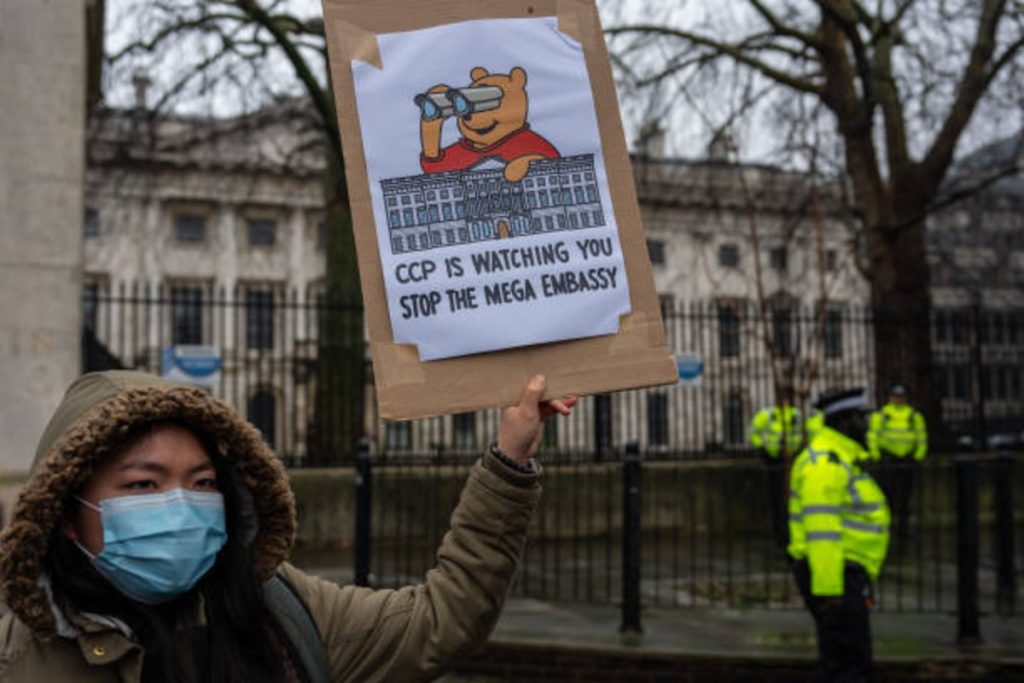
A protester demonstrates at the proposed site of China’s new embassy in central London. Carl Court/Getty Images.
In a decision issued on Tuesday, Housing Secretary Steve Reed granted both planning permission and listed building consent for the redevelopment of the former Royal Mint site, located close to the Tower of London and other major heritage landmarks. The approval clears the way for what would become the largest embassy complex in the United Kingdom by land area, and one of the most expansive diplomatic missions situated in the centre of a Western capital.
The project would see China relocate its embassy from its current premises in London’s upmarket Marylebone district to a significantly larger site on the eastern edge of the City of London. Chinese officials have argued that the existing embassy no longer meets the operational demands of China’s expanding diplomatic and consular presence in Britain.
Despite the approval, the development remains controversial and could still face legal challenges, with opponents warning of security risks, restrictions on public protest, and potential damage to the character of one of London’s most historic areas.
A Long-Running and Contested Proposal
China purchased the former Royal Mint site in 2018 after the UK Treasury sold the property as part of a broader programme to dispose of government-owned assets. The 5.5-acre site includes several listed buildings and occupies a prominent location near major tourist attractions along the River Thames.
Early redevelopment proposals were submitted shortly after the purchase but quickly met resistance. Local authorities, conservation groups and civil liberties organisations raised concerns over the scale of the embassy, its proximity to sensitive heritage sites, and the potential implications for demonstrations and public access.
The planning process was repeatedly delayed as relations between London and Beijing cooled over issues including Hong Kong, Xinjiang and allegations of Chinese interference abroad. The project underwent multiple revisions and public consultations before being referred to a formal public inquiry.
Government Decision and Official Rationale
In his official decision letter, Reed said he accepted the conclusions of the planning inspector, who found that the proposal complied with national planning policy and that any harm to heritage assets would be outweighed by wider public benefits.
Reed confirmed that he was granting both planning permission and listed building consent, allowing China to refurbish historic structures on the site while constructing new buildings as part of the embassy complex.
The decision letter said the development would secure the long-term use of the former Royal Mint buildings and deliver diplomatic and economic benefits. UK officials have stressed that planning decisions are assessed independently of foreign policy considerations.
Scale and Strategic Significance
Once completed, the China mega embassy in London would be significantly larger than the country’s existing mission and would surpass all other embassies in the UK in terms of land area. The complex is expected to house diplomatic offices, residential quarters, consular services and secure facilities.
Its location near the Tower of London and Tower Bridge places it within one of the most closely monitored and historically significant districts in the capital. Critics argue that such a large diplomatic installation could alter the character of the area and increase security pressures.
Supporters of the project say the embassy reflects the scale of the UK–China relationship and would improve diplomatic engagement, trade dialogue and consular services for Chinese nationals living in or visiting Britain.
Opposition From Residents and Rights Groups
Opposition has remained strong among some local residents, who have raised concerns about increased policing, restricted access and traffic disruption in the surrounding area.
Human rights organisations have warned that the embassy’s size and security footprint could limit protest activity nearby. The Royal Mint site has previously hosted demonstrations, including protests critical of the Chinese government.
Groups representing Hong Kong activists, Uyghur advocates and Tibetan organisations argue that the development could deter lawful demonstrations and create a chilling effect on freedom of expression.
Political Reaction and Parliamentary Scrutiny
The decision has drawn mixed reactions in parliament. Some lawmakers have questioned whether national security considerations were sufficiently addressed, while others warned that rejecting the project could have damaged diplomatic relations with Beijing.
Ministers have defended the approval, saying security matters fall under the responsibility of intelligence and law enforcement agencies rather than the planning system.
China’s Position and Diplomacy
Chinese officials have consistently said the new embassy is intended solely for diplomatic and consular purposes. In previous statements, China’s embassy in London described the Marylebone site as outdated and unsuitable for current needs.
The approval comes as the UK government seeks a more stable but cautious relationship with Beijing, balancing economic engagement with concerns over security and human rights.
Potential Legal Challenges
Legal experts say opponents could still seek a judicial review of the decision, potentially delaying construction. Campaigners have indicated they are examining legal options, arguing that concerns over protest rights and public safety were not fully addressed.
The government has said it is confident the decision would withstand legal scrutiny.
With planning permission now granted, China may proceed with detailed design and preparatory work, subject to meeting planning conditions and heritage requirements.
Related: China Introduces Condom and Contraceptive Drug Tax to Address Declining Birth Rates
No official construction timeline has been announced. Given the scale of the project and the possibility of legal challenges, it could be several years before the embassy becomes fully operational.
The approval marks a significant milestone in one of London’s most closely watched planning disputes, highlighting the intersection of diplomacy, urban development and geopolitics in the heart of the UK capital.