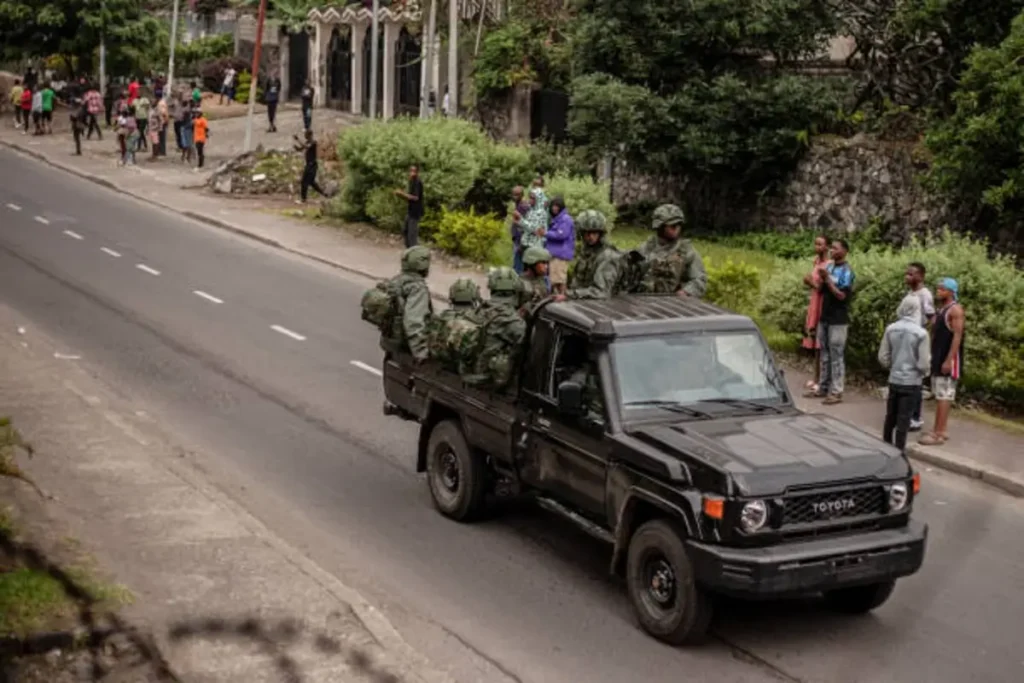
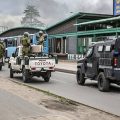
Members of the Rwanda-backed M23 armed group travel through a street in Goma, Democratic Republic of the Congo, January 29, 2025. AFP via Getty Images.
UVIRA, Democratic Republic of the Congo (Epicstorian News) — Rwanda‑backed M23 rebels announced on Tuesday that they will withdraw their forces from the strategic eastern town of Uvira in response to a direct request from the United States aimed at reinforcing regional peace efforts.
This development followed a significant offensive in which the group seized Uvira last week, deepening a conflict that has forced hundreds of thousands from their homes.
Corneille Nangaa, the political coordinator of the Congo River Alliance coalition that includes the M23 movement, described the decision as a “unilateral trust‑building measure” to give the ongoing peace process under international mediation the best chance to succeed.
He said the group would begin withdrawing fighters in stages but stressed conditions including demilitarization and the protection of civilians must be guaranteed.
Uvira’s capture and tactical significance
Uvira, located on the northern shores of Lake Tanganyika near the Burundian border, was rapidly seized by M23 fighters earlier this month following an offensive that began in early December. According to reports from residents and humanitarian officials in the region, the Congolese army and allied militias withdrew from their positions, leaving the town exposed to the advancing rebels.
The capture of Uvira represented a major shift in territorial control in South Kivu province, extending the rebel group’s influence beyond previously held areas and potentially opening pathways for further operations deeper into southeast Congo.
Uvira’s port on Lake Tanganyika makes it a crucial logistical and economic hub, connecting the region to international trade routes.
U.N. and humanitarian sources said that the fighting around Uvira and other contested areas in South Kivu has contributed to a rapidly worsening humanitarian crisis, with deaths and mass displacement among the civilian population.
Agencies on the ground estimated at least 200,000 people have fled their homes in recent weeks amid renewed clashes, adding to millions displaced since the conflict escalated earlier this year.
International mediation and peace agreements
The confrontation around Uvira unfolded just days after Congolese President Félix Tshisekedi and Rwandan President Paul Kagame met with U.S. President Donald Trump in Washington to sign a comprehensive peace accord designed to restrain hostilities in eastern Congo.
The so‑called Washington Accords sought to solidify commitments to ceasefire and political dialogue, though the text did not include direct participation by the M23 movement.
U.S. Secretary of State Marco Rubio publicly criticized the capture of Uvira as undermining the Washington peace agreement, saying the actions of Rwanda and forces backing the rebels violated the framework’s terms.
Rubio emphasized that American diplomacy aimed to strengthen calm and push all parties back to negotiations rather than uncontrolled military expansion.
Rwanda has consistently denied direct command or control over the M23 fighters, framing its actions in the region as defensive measures in response to threats from armed groups opposed to Kigali’s security interests.
International observers, however, have cited evidence of Rwandan military engagement in support of the rebels, making the situation one of the most sensitive facets of regional diplomacy.
Doha negotiations and rebel engagement
As part of the broader effort to halt the fighting, separate peace negotiations have been underway between the Congolese government and M23 representatives under Qatari facilitation in Doha. These talks have sought to stabilise the conflict and cement a durable ceasefire that could lead to a more comprehensive political settlement.
M23’s withdrawal announcement referenced the Doha peace process as a primary motivation, with Nangaa asserting that the move was intended to “give the peace efforts the maximum chance to succeed.” However, observers note that the rebels have historically used tactical withdrawals and redeployments to gain leverage in negotiations without fully relinquishing territorial control.
Despite the declaration, residents of Uvira reported seeing armed rebel fighters still present in parts of the town on Tuesday, indicating that implementation of the pullback may be gradual and contested on the ground. Some locals also expressed concern that fighting could resume if conditions on the ground do not change substantively.
Humanitarian impact and civilian conditions
The fighting in eastern Congo has inflicted heavy tolls on the civilian population, exacerbating what aid organisations describe as one of the world’s most severe humanitarian emergencies. More than 7 million people have been displaced since renewed hostilities began, and agencies warn that ongoing insecurity is hampering the delivery of food, shelter and medical care.
Hospitals and clinics in affected areas, including Uvira, have reported overloads of injured civilians, and burial teams document rising civilian fatalities. Humanitarian workers caution that without secure access routes and sustained ceasefire conditions, displacement and suffering are likely to intensify in the coming weeks.
Neighbouring Burundi has faced an influx of refugees fleeing the conflict, and has temporarily closed its border with eastern Congo to manage the flow of people and security concerns. Officials in Bujumbura have expressed alarm over the proximity of fighting to their border and the potential for destabilising spillover if hostilities persist.
Reactions from governments and international bodies
Congo’s government reiterated its resolve to regain control of Uvira and secure stability across the region. A senior spokesman for the Congolese armed forces said government troops were preparing to reestablish authority in the town, pointing to progress in counter‑offensives in nearby areas.
The United Nations and European Union have called for all parties to comply fully with international law and ceasefire obligations, stressing the importance of protecting civilians and ensuring humanitarian access. U.N. human rights monitors have also accused some armed groups operating in the region of abuses, underscoring the urgent need for improved security conditions.
Rubio and other Western officials have indicated that diplomatic consequences, including restrictions or targeted sanctions, could be considered if peace deal commitments are not upheld by all stakeholders. Such measures are intended to reinforce compliance with negotiated frameworks and deter further escalation.
Regional implications and future prospects
Military analysts say that while M23’s tactical withdrawal could reduce immediate tensions in Uvira, the group’s broader strategic objectives and territorial ambitions remain unresolved. M23’s expansion earlier this year included the capture of other major towns, including Bukavu, weakening the Congolese government’s hold over key parts of South Kivu.
Domestically, eastern Congo’s fluid security environment has also drawn in dozens of local militias and community self‑defence groups, complicating efforts to demobilise combatants and disentangle armed networks.
The presence of valuable mineral resources throughout the region, including coltan and gold, adds economic incentives to the conflict’s persistence.
Observers say that successful peace implementation will require strengthened verification mechanisms, engagement by regional actors, and sustained humanitarian support to mitigate the deep socio‑economic impact of years of violence.
Related: Tanzania Security Forces Block Independence Day Protests after Government Warns of ‘Coup Attempt’
Continued diplomatic engagement in venues such as Doha, Washington, and Kampala may prove critical to achieving lasting calm.
For now, Uvira remains a focal point of competing diplomatic, military and humanitarian priorities, with international pressure and local realities shaping the next phase of the conflict.
Up next
 Zimbabwe Police Launch Murder Probe After 13-Year-Old Kills Friend in Snack Dispute
 Benin president vows ‘no impunity’ after soldiers claim to seize power
 Tanzania Security Forces Block Independence Day Protests after Government Warns of ‘Coup Attempt’
 Airtel Africa Partners With Starlink to Expand Satellite Internet Across 14 Markets