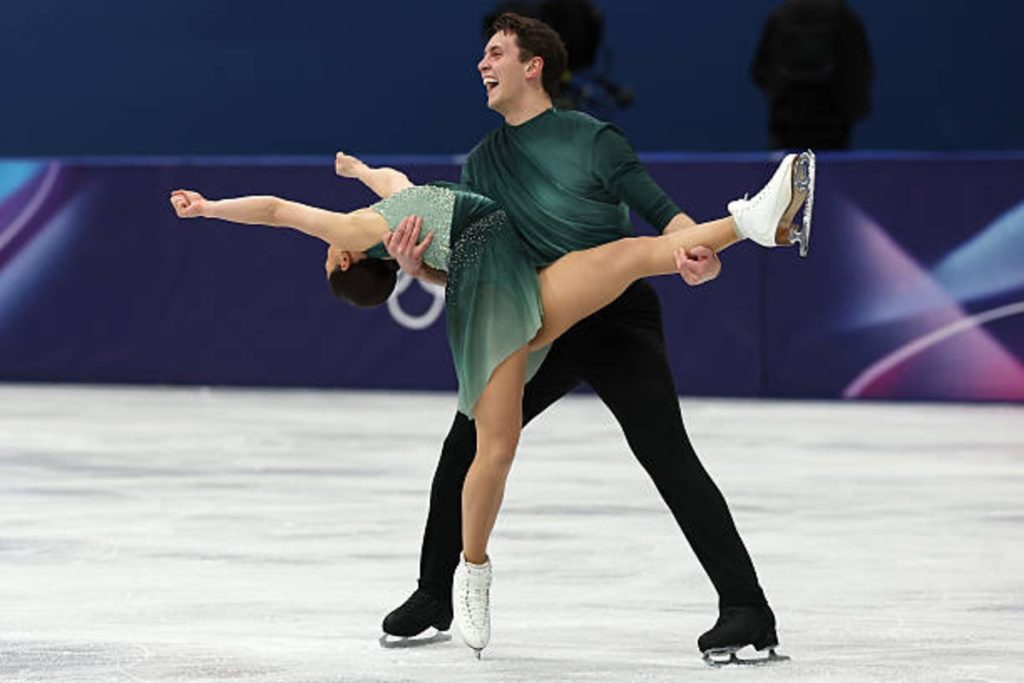
Anastasia Vaipan-Law and Luke Digby compete in the pairs short program on Day 9 of Milano Cortina 2026 in Milan, Italy.Elsa/Getty Images
Pairs Short Program Structure
The short program requires skaters to perform a prescribed set of elements under International Skating Union (ISU) regulations. These elements include a twist lift, throw jump, side-by-side jump, lift, pair spin, solo spin combination and step sequence.
Each element carries a base value. Judges award Grades of Execution (GOE), which adjust the base value upward or downward depending on quality. In addition to the Technical Element Score (TES), judges evaluate skating skills, transitions, performance, composition and interpretation to produce the Program Component Score (PCS).
The total segment score determines ranking after the short program. Only the highest-ranked pairs advance to the free skate, where medals are decided.
Milano Ice Skating Arena Venue
The Milano Ice Skating Arena serves as one of the primary venues for figure skating at the 2026 Winter Olympics. The Games are jointly hosted by Milan and Cortina d’Ampezzo, marking Italy’s third time hosting the Winter Olympics following Cortina 1956 and Turin 2006.
The venue has been configured to meet Olympic and ISU standards, including ice quality specifications, broadcast infrastructure and judging systems. Figure skating sessions are scheduled throughout the Games, drawing global television audiences.
Team Great Britain Representation
Vaipan-Law and Digby qualified for the Olympic Games through the international qualification system governed by the ISU and their national federation. The pair has competed in European Championships and ISU Grand Prix events in the lead-up to the Olympics.
Their appearance in Milan adds to Great Britain’s Olympic figure skating history. Britain has previously won Olympic medals in figure skating disciplines, including ice dance and pairs, across multiple Winter Games.
The short program performance on Day 9 represents the first of two competitive segments in the pairs discipline at Milano Cortina 2026.
Olympic Figure Skating at Milano Cortina 2026
Figure skating remains one of the most widely followed sports at the Winter Olympics. The discipline combines athletic execution with choreographed performance, judged under the ISU scoring system introduced in 2004.
At Milano Cortina 2026, figure skating events are scheduled across multiple days, with medal ceremonies following the conclusion of each discipline.
The pairs competition is traditionally one of the most technically demanding disciplines due to high-risk elements such as throw jumps and lifts performed in close synchronization.
Day 9 Winter Olympics
Day 9 of the Winter Olympics featured competitions across several sports, including speed skating, alpine skiing, biathlon and ice hockey, alongside figure skating.
The Olympic Games officially opened on February 6, 2026. Athletes from more than 80 nations are competing across winter sport disciplines governed by international federations.
The Milano Cortina 2026 Games continue through February, with medal events scheduled daily across host venues in northern Italy.
Pairs Competition
Following the completion of the short program, qualified pairs will compete in the free skate segment. Scores from both segments are combined to determine final Olympic placements.
The free skate allows longer program duration and expanded technical content, including additional lifts, throws and jump combinations.
Final medal standings in the pairs discipline will be confirmed after the free skate segment concludes later in the competition schedule.