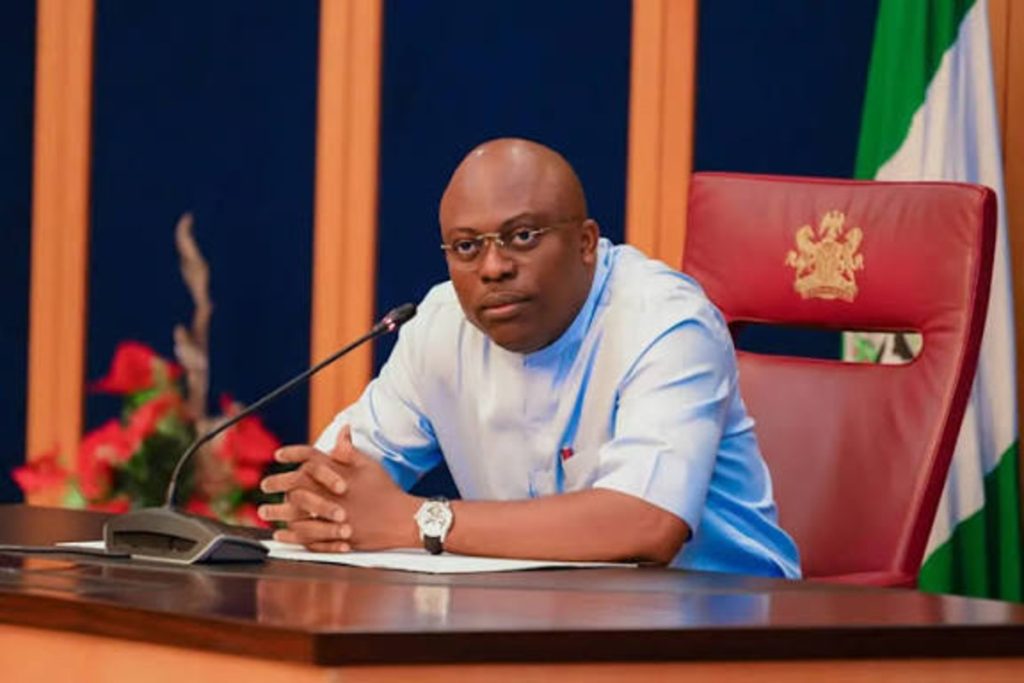
Rivers State Governor Siminalayi Fubara during official duties as Rivers Assembly impeachment stalls after missed plenary.
Plenary does not hold as deadline lapses
Lawmakers had adjourned proceedings on 8 January 2026 after serving a notice of alleged gross misconduct on the governor and his deputy.
The notice was issued under Section 188 of the 1999 Constitution, which outlines the procedure for removing a sitting governor.
On Thursday, however, there was no legislative activity at the Assembly’s usual sitting venue. The complex remained closed, with security personnel positioned at the entrance.
Assembly officials earlier indicated that no sitting would hold on the day the ultimatum expired.
Origins of the impeachment move
The impeachment notice followed weeks of political tension between the Assembly leadership and the state executive.
Lawmakers accused the governor and his deputy of actions they described as gross misconduct, including the demolition of the Assembly complex and spending public funds without legislative approval.
The allegations formed the basis of the impeachment notice and the decision to invoke constitutional provisions.
The move represented a sharp escalation in a dispute that has disrupted governance in the oil-producing state.
Appeals for restraint within the Assembly
Earlier in the week, a group of Assembly members publicly urged their colleagues to halt the impeachment process.
The lawmakers called for dialogue, cautioning that the political crisis required broader consultation and careful consideration of its implications for the state.
They said their appeal reflected concerns raised by political elders and stakeholders who favoured reconciliation over confrontation.
The intervention underscored internal divisions within the legislature over the impeachment approach.
Public anticipation and political uncertainty
The failure of the Assembly to meet came amid heightened public attention, with residents awaiting clarity on whether impeachment proceedings would advance.
The missed plenary added to uncertainty surrounding the political future of the state and the stability of its institutions.
No new date for legislative action has been announced.
National attention on Rivers crisis
The developments have drawn attention beyond Rivers State, reflecting wider concern about political instability in subnational governments.
While no formal federal position has been announced, the situation continues to be closely watched by political actors at the national level.
The pause in proceedings has fuelled expectations of possible behind-the-scenes engagement aimed at de-escalation.
Governor continues official duties
Governor Fubara has continued with scheduled official engagements since the impeachment notice was issued.
He has not publicly addressed the allegations or the stalled legislative process.
His administration has maintained routine government operations amid the political uncertainty.
What the constitution provides
Under Nigeria’s constitution, impeachment involves multiple stages, including legislative resolutions, investigation by an independent panel, and supermajority votes.
Related: Delta Governor Distributes 65 SUVs to Monarchs to Strengthen Community Leadership
The absence of a plenary means the process cannot advance to the next procedural stage.
Legal and political analysts note that delays can significantly alter the trajectory of impeachment efforts.
Unclear path forward
It remains uncertain whether the Assembly will reconvene to pursue the impeachment or shift toward political negotiation.
For now, the impeachment process is effectively on hold.
The coming days are expected to determine whether the standoff deepens or gives way to compromise.
Reporting by Ann Godwin; Editing by Epicstorian News Desk.