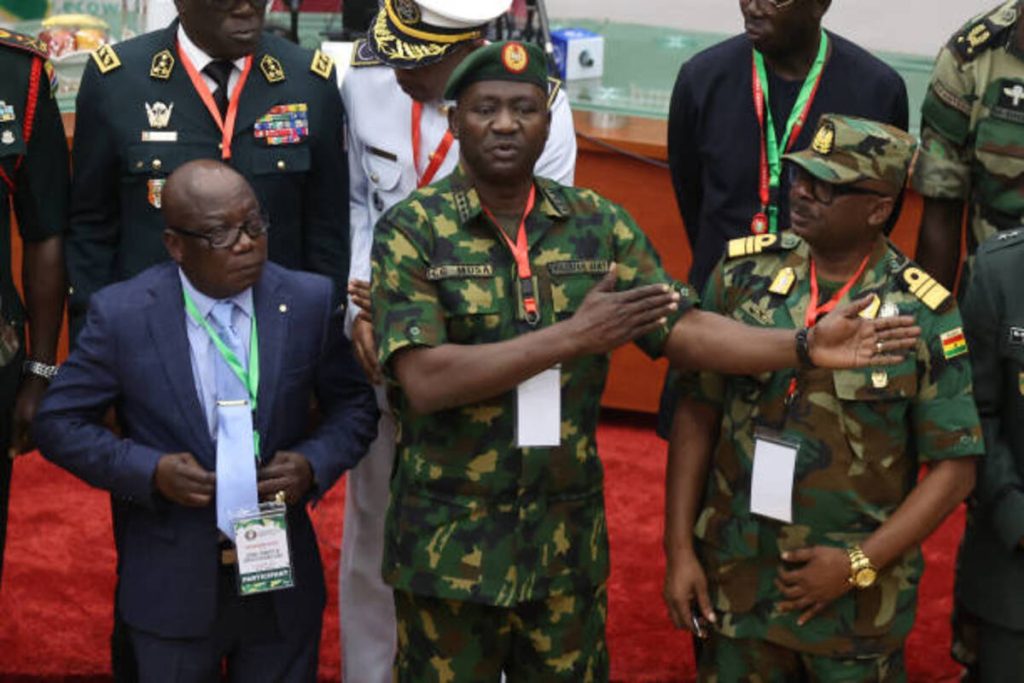
Military officials meet in Abuja. Kola Sulaimon/AFP via Getty Images.
The prosecution follows weeks of interrogations by military intelligence and security agencies after a series of coordinated arrests across the country.
Special Panel Submits Findings on Alleged Coup Attempt
The Special Investigative Panel, chaired by Major General Emmanuel Undiendeye, has reportedly completed its preliminary findings for submission to the presidency.
According to reports citing unnamed government sources, the panel identified more than thirty individuals for prosecution, while seven others remain at large.
Authorities said those still on the run have switched off all known communication devices, making tracking operations more difficult for security agents.
Military intelligence operatives are conducting what they describe as a targeted manhunt across several Nigerian states to locate the fugitives.
Officials said those arrested would be tried either before military tribunals or in civil courts, depending on their service status.
Defence Headquarters and Presidency Briefed
The Chief of Defence Intelligence and his team are expected to brief the Chief of Defence Staff, General Christopher Musa, on the latest progress.
Sources said the Defence Headquarters intends to issue a formal statement once the president reviews the report.
In previous remarks, the Defence Headquarters had described its internal inquiry as a routine measure to preserve discipline within the Armed Forces.
The Defence Headquarters statement did not confirm or deny the existence of a coup plot, but investigations reportedly intensified following credible intelligence signals.
Reports indicate that the suspects had discussed targeting key national figures, including President Tinubu, Vice President Kashim Shettima, and the heads of both chambers of parliament.
Military Officers Among the Accused
Security sources revealed that most of the suspects currently detained are serving officers within the Nigerian Army, Navy, and Air Force.
At least fourteen of them are reportedly from the Army, while two others are from the Navy and Air Force combined.
The new round of arrests, carried out in late October, expanded the number of detained officers to over thirty.
The names of the latest suspects have not yet been made public pending presidential approval of the panel’s recommendations.
The investigation reportedly uncovered meetings and exchanges between some officers aimed at coordinating plans to destabilize the government.
Former Minister Denies Involvement in Alleged Coup Attempt
Former Bayelsa State governor and ex-minister of petroleum, Timipre Sylva, denied involvement in the alleged coup after soldiers raided his residence in Abuja.
His spokesperson, Julius Bokoru, said the operation caused “considerable damage” to the property and that Mr Sylva was out of the country during the incident.
Bokoru added that no official explanation has been provided to the former minister or his aides about the reason for the raid.
Mr Sylva’s denial was made public shortly after media reports linked the search to the ongoing military investigation.
The former governor has not yet been formally accused or listed among the thirty suspects identified by the panel.
Tinubu Administration Reshuffles Military Leadership
Weeks after the initial arrests, President Tinubu approved significant changes within the nation’s military hierarchy.
The reshuffle replaced the Chief of Defence Staff and several service chiefs in what the presidency described as an operational adjustment.
Officials have not directly connected the leadership changes to the ongoing investigation, but security analysts say the timing reflects the administration’s intent to reinforce control within the Armed Forces.
President Tinubu, who took office in May 2023, has repeatedly emphasized his commitment to democratic governance and civilian oversight of the military.
The presidency has not commented publicly on whether the alleged coup plot influenced the restructuring decisions.
Regional Security Implications
Observers note that the alleged plot comes amid increased security concerns in West Africa following multiple military coups in recent years.
Since 2020, countries including Mali, Burkina Faso, and Niger have witnessed successful military takeovers that reshaped regional stability.
Analysts believe Nigerian authorities are determined to avoid any perception of vulnerability within Africa’s largest democracy.
The incident has drawn international attention due to Nigeria’s leading role in the Economic Community of West African States (ECOWAS) and its opposition to unconstitutional power seizures in neighboring countries.
Military officers under investigation are alleged to have cited regional examples to justify their plans, according to reports referencing intelligence briefings.
Legal Process for the Alleged Coup Attempt
Officials said military prosecutors are preparing case files for court-martial proceedings under the Armed Forces Act.
Civilian participants will face charges under Nigeria’s criminal laws, likely through the Federal High Court in Abuja.
The Justice Ministry is expected to coordinate with the Defence Headquarters to determine jurisdiction and trial scheduling.
The process will test Nigeria’s judicial independence in balancing national security interests with constitutional rights.
Legal analysts say the government’s handling of the case will be closely monitored by regional partners and international observers.
Government Response to the Alleged Coup Attempt
The presidency has not issued a public statement directly addressing the alleged coup attempt but continues to receive updates from the military panel.
Officials said President Tinubu would be briefed once final recommendations are reviewed by the Chief of Defence Staff.
The government’s communication approach, described by analysts as cautious, appears aimed at preventing panic or political speculation.
The National Security Adviser’s office has remained silent on whether broader arrests could follow once the fugitives are located.
Law enforcement agencies have also declined to disclose the specific timeline for prosecutions.
Reactions Within Nigeria’s Political and Security Circles
Political commentators have described the arrests as the most significant test of military loyalty since the return of civilian rule in 1999.
Human rights groups have called on authorities to ensure transparency in the trial process and uphold the rights of those detained.
Members of parliament have urged the government to strengthen oversight of the Armed Forces to prevent further breaches of discipline.
The Attorney-General’s office has reiterated the government’s commitment to due process in all security-related prosecutions.
Security experts say the alleged plot underscores persistent structural and morale issues within parts of the military establishment.
International Reactions to Nigeria’s Alleged Coup Attempt
Foreign governments and international organizations have expressed support for Nigeria’s constitutional order and condemned any attempt to destabilize it.
The African Union (AU) has consistently reaffirmed its zero-tolerance stance on unconstitutional changes of government.
Diplomatic observers said Nigeria’s swift response could serve as a deterrent across the region, where coups have undermined civilian governance.
The United States and the European Union (EU) have maintained close engagement with Nigerian authorities over domestic security issues and democratic reforms.
Analysts warn that any confirmed coup attempt in Nigeria could have far-reaching geopolitical consequences across West Africa.
Next Steps in the Alleged Coup Attempt Case
Officials said the Defence Headquarters is finalizing documentation to present its findings formally to President Tinubu.
The report, once reviewed, will determine the charges and the legal framework for the upcoming prosecutions.
Security agencies are expected to continue tracking the seven missing suspects believed to have fled their duty posts or crossed into neighboring states.
Authorities have urged cooperation from the public in providing credible information to assist ongoing operations.
The Defence Headquarters has pledged that the process will follow established legal norms and maintain institutional integrity.
Analysts See Broader Implications for Governance
Political analysts argue that the investigation signals a critical moment for civil-military relations in Nigeria.
The event highlights long-standing tensions between democratic institutions and segments of the Armed Forces.
Experts say the administration’s firm response reflects its intent to deter future attempts at undermining civilian authority.
They also note that maintaining public confidence will depend on transparency and adherence to rule of law principles.
For Nigeria, the outcome of this case could redefine the balance between national security enforcement and constitutional governance.
The government is under pressure to demonstrate accountability while reinforcing the military’s professionalism in an increasingly complex regional environment.