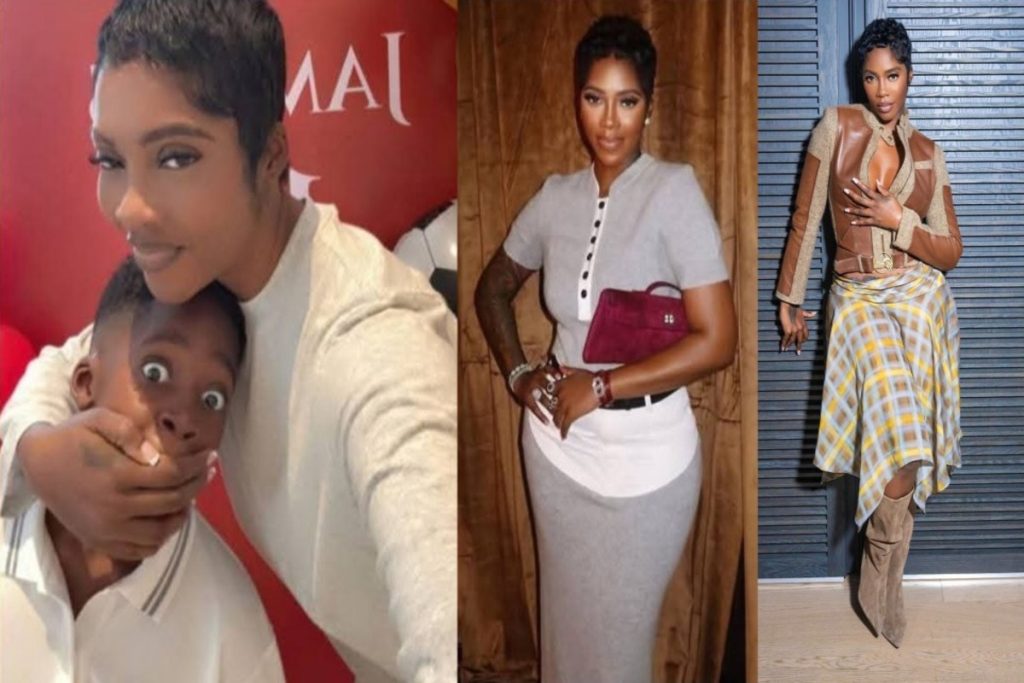
Tiwa Savage enforces chores, routines, and discipline for son Jamil while managing her global music career.
Lagos, Nigeria (Epicstorian News) – Nigerian musician and Afrobeats performer Tiwa Savage has publicly detailed her approach to raising her son, Jamil Balogun, with discipline and structured limits alongside her global music career.
Savage’s comments were shared via her official social media account, where she outlined specific routines and expectations for her child that she said are intended to instill a strong work ethic and personal responsibility regardless of her celebrity status.
The singer, known for her chart‑topping albums and international tours, said in an Instagram story that she aligned her parenting approach with a message from business leader and pastor Ibukun Awosika that warns against excessive privilege weakening ambition in children.
According to Savage, children who receive all comforts without effort risk lacking the drive to pursue goals independently.
Savage’s son Jamil, whom she shares with her former husband Tunji “TeeBillz” Balogun, was born in 2015 when the singer was at the early stages of her mainstream career.
The breakup of Savage and Balogun occurred in 2016 amid highly publicised personal disputes.
Within hours of introducing her parenting philosophy on social media, Savage provided specific examples of her methods. She said that although she frequently has access to private flights due to her professional engagements, she chooses to place her son in economy class when travelling on commercial flights so he experiences everyday scenarios that differ from her professional lifestyle.
Recounting one recent flight, the singer noted that Jamil expressed discomfort about limited legroom and neck strain, which she said was typical given his age and height at the time.
She explained that although the child was accompanied by a nanny, she monitored him personally throughout the journey.
In subsequent posts, Savage described her strategy for teaching her son the value of earning privileges rather than receiving them unconditionally.
She said that items such as digital games are not simply provided but must be earned through household chores or good academic performance.
Savage also indicated that she restricts access to certain comforts, such as electronic devices and snacks on weekdays, and has established nightly Bible study routines.
Savage’s remarks have generated varied reactions on social media platforms, including commentary about her specific parenting choices.
In past interviews, she acknowledged the importance of support structures, including assistance from family and long‑term childcare providers, to help manage the dual demands of her career and parenting responsibilities.
In an interview on a Nigerian entertainment programme, she detailed how her own mother and a longstanding nanny have contributed to raising her son from infancy through his formative years, reinforcing the idea that caregiving often involves a broader network beyond the immediate parental role.
Savage has also previously commented publicly on the complexities of combining a high‑profile music career with family life, particularly during the COVID‑19 pandemic when she worked from home.
She described how maintaining separation between professional studio time and family interactions required deliberate effort.
While outlining her current parenting philosophy, Savage did not specify her views on whether her son should follow her footsteps in the music industry.
In interviews last year, she suggested she would be cautious about encouraging him to pursue music professionally due to the industry’s demanding nature and competitive landscape. 10
Savage’s social media posts included references to motivational content about ambition, emphasizing that aspirations should exceed an individual’s current reality, a point she said she wants her son to internalize as part of his character development.
Her online commentary about parenting followed previous public statements in which she has reflected on the emotional dimensions of parenthood, including moments where discipline and affection intersect within everyday family life.
Local media sources covering Savage’s comments highlighted that her parenting style incorporates structured limitations alongside rewards contingent on effort, a theme that has elicited discussion among audiences about how celebrity parents navigate privilege and expectation.
In addition to her personal posts, Savage’s broader public profile includes recognition in various artistic arenas.
She has featured on lists of influential women and maintained a high profile in the African and global music scenes, with international performances and collaborations contributing to her prominence.
Alongside her professional work, Savage’s choices as a parent reflect a context in which global audiences often see the personal lives of public figures unfold across social platforms, providing real‑time visibility into family decisions that may otherwise remain private.
As discussions around her statements continued online, responses varied from those focusing on her methods to others recalling aspects of her wider public life and career.
Some commentators referenced unrelated past controversies in debates about her parenting perspective, illustrating the intersection of personal life and public perception in the digital era.
Tiwa Savage’s parenting disclosures underscore a consistent pattern in her public communications where she combines reflections on her career, personal values, and family with engagement on social media platforms that reach international audiences.
Born in 1980 and rising to prominence with successive studio albums, her trajectory has included global performances and recognition, including contributions that have influenced other artists in the Afrobeats genre.
Related: Chimamanda Ngozi Adichie’s Son Nkanu Nnamdi Dies After Brief Illness
The narrative surrounding Savage’s approach to raising her son with defined limits and expectations continues to be discussed within public forums and entertainment media, reflecting broader conversations about parenting practices among high‑profile individuals in contemporary society.