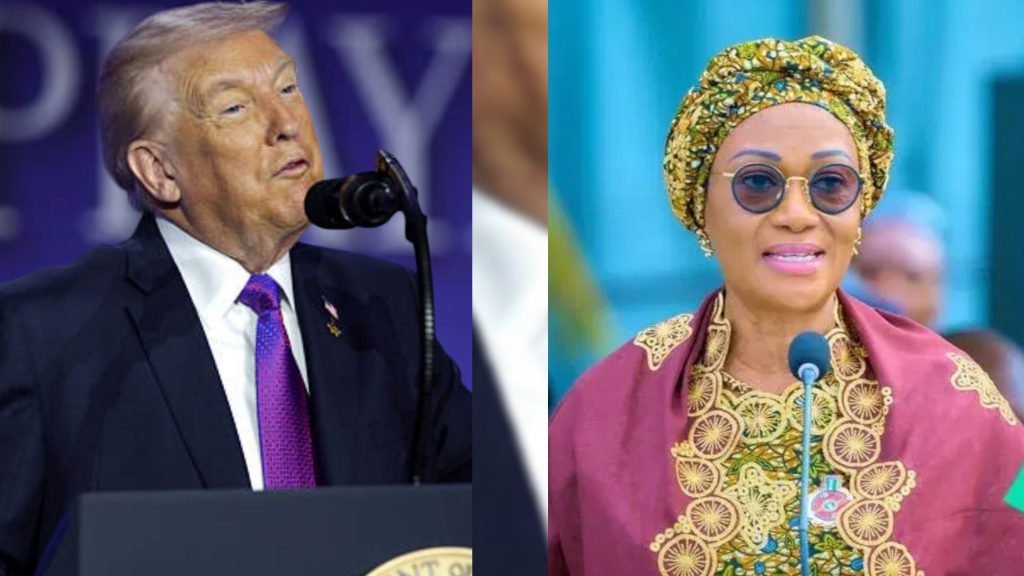
Trump and Nigeria’s First Lady Remi Tinubu featured at the 74th National Prayer Breakfast, Washington DC. Alex Wong/ Vanguard/ Getty Images
Washington, D.C. (Epicstorian News) — The United States President Donald Trump made a rare public acknowledgment of Nigeria’s First Lady, Senator Oluremi “Remi” Tinubu, during the 74th National Prayer Breakfast in Washington, D.C.
He described Tinubu as a “very respected woman” and highlighted her pastoral role at one of Nigeria’s largest churches.
Such recognition of a foreign first lady is unusual for this annual event. Observers note that it is rare for leaders outside the U.S. to be singled out in this manner, making the acknowledgment both ceremonial and symbolically significant.
“We’re honoured to be joined today by the First Lady of Nigeria, who also happens to serve as a Christian pastor at the largest church in Nigeria. A very respected woman,” Trump said. “First Lady, please, where are you? Thank you very much. It’s a great honour to have you with us.”
The National Prayer Breakfast as a Forum
The National Prayer Breakfast convenes annually with U.S. lawmakers, faith leaders, and international guests to discuss leadership, governance, and moral issues. While officially a religious observance, it has long served as a soft diplomacy platform, where appearances and acknowledgments carry symbolic weight.
Trump’s emphasis on Tinubu’s faith credentials highlights the intersection of religious and political influence — a dual authority that holds considerable sway in Nigeria. Analysts suggest the acknowledgment may enhance her international visibility and subtly reinforce Nigeria’s role in transnational faith networks.
Who Is Remi Tinubu?
Oluremi Tinubu has served as Nigeria’s First Lady since May 29, 2023. She previously represented Lagos Central as a senator from 2011 to 2023 and was First Lady of Lagos State. Beyond politics, she was ordained as a pastor in the Redeemed Christian Church of God in 2018, making her pastoral role both formal and publicly recognized.
Faith as a Vector of Influence
Trump’s remarks underscore the growing influence of religious leadership in African politics. In Nigeria, faith communities play a critical role in shaping public opinion, social norms, and civic engagement. Recognition of Tinubu’s religious authority alongside her political position signals soft power influence, though largely symbolic.
For the U.S., engaging prominent foreign faith leaders can complement diplomatic messaging, aligning shared moral values with strategic interests. Observers note, however, that the practical impact of such acknowledgments remains limited without substantive follow-up.
Soft Power and Diplomatic Signaling
While ceremonial, the acknowledgment coincides with ongoing U.S.-Nigeria discussions on security, trade, and religious freedom. Publicly praising a foreign leader’s religious role reinforces narratives of legitimacy and influence, but it also raises questions about the depth of engagement behind symbolic gestures.
Analysts note that these moments contribute to Nigeria’s soft power profile but emphasize that the rarity of the visit and absence of concrete outcomes suggest its impact is largely reputational rather than policy-driven.
Media Reception and Public Interpretation
Coverage across Nigerian and international media highlighted Tinubu’s combined political and religious identity. Social media responses reflected curiosity, intrigue, and scrutiny over the strategic significance of this rare acknowledgment.
Related: Maduro’s Arrest, Oil, Power and Alleged Drug Business Using U.S. as Consumer Market
Analysts suggest that while the moment garners attention, it also exposes the performative aspects of faith diplomacy in contemporary global politics.
Trump’s acknowledgment illustrates the complex interplay between ceremonial recognition, religious authority, and international perception.
It elevates Nigeria’s presence on a global stage while raising questions about the tangible outcomes of symbolic diplomacy.