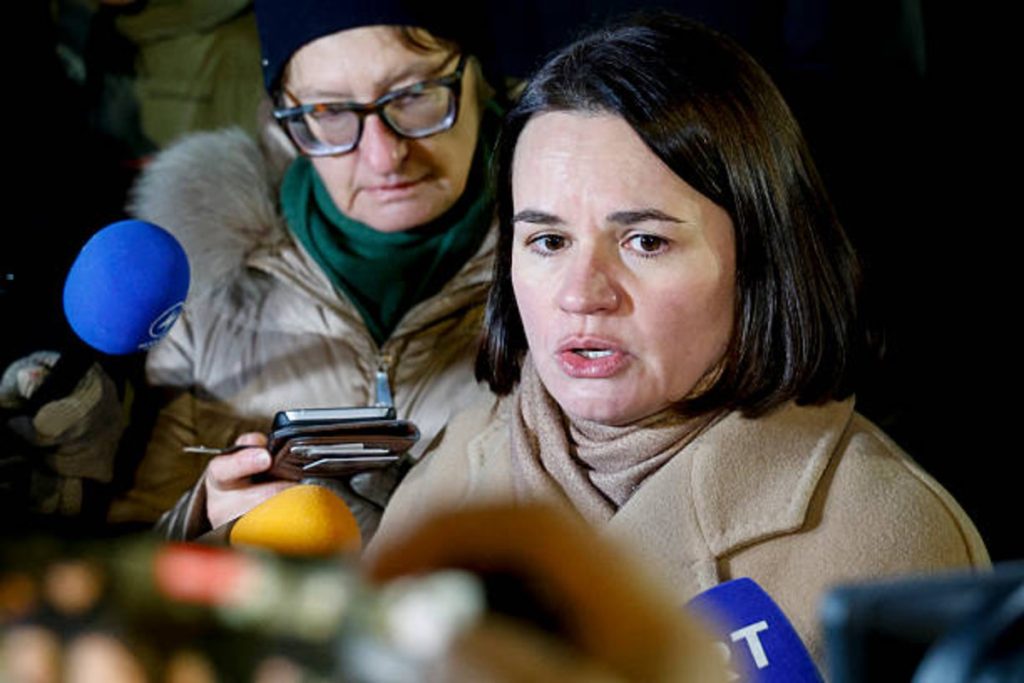
Belarusian opposition leader Sviatlana Tsikhanouskaya speaks to journalists at the U.S. embassy in Vilnius, Lithuania, December 13, 2025. Maria Kalesnikava and Nobel laureate Ales Bialiatski were freed the same day among 123 political prisoners.Petras Malukas/AFP via Getty Images
Diplomatic Talks Lead to Prisoner Release
The release followed meetings in Minsk between Lukashenko and John Coale, a U.S. envoy representing President Donald Trump. During the talks, Washington agreed to lift sanctions on Belarusian potash, a key fertiliser ingredient and one of the country’s most important export products.
Coale said the decision to ease restrictions was taken under direct instructions from Trump. The move marks the largest prisoner release by Lukashenko since his administration opened talks with Washington earlier this year.
Bialiatski and Kalesnikava Freed
Bialiatski, co-winner of the 2022 Nobel Peace Prize, had been imprisoned since July 2021 after years of campaigning on behalf of political detainees. Kalesnikava emerged as a leading figure during mass protests against Lukashenko following the disputed 2020 presidential election.
Viktar Babaryka, who was arrested in 2020 while preparing to challenge Lukashenko at the polls, was also among those released. Tatsiana Khomich, Kalesnikava’s sister, confirmed she had spoken to her by phone shortly after the release.
Sanctions Easing Boosts Belarusian Economy
The United States and the European Union imposed wide-ranging sanctions on Belarus after authorities violently suppressed protests following the 2020 election. Restrictions were expanded in 2022 after Belarus allowed Russian forces to use its territory as a staging ground for the invasion of Ukraine.
The easing of U.S. sanctions on potash is expected to provide a significant economic boost. Belarus is among the world’s largest producers of the fertiliser component, which had been heavily affected by trade restrictions.
Lukashenko’s Position on Political Prisoners
Lukashenko has repeatedly denied the existence of political prisoners in Belarus, describing jailed opponents as criminals and accusing them of undermining the state. As recently as August, he questioned why detainees should be freed if they could “again wage war against us.”
Trump has publicly urged Lukashenko to release up to 1,400 detainees, referring to them as “hostages.” Belarusian human rights group Viasna said that 1,227 political prisoners remained in custody on the eve of Saturday’s releases.
U.S. Strategic Engagement
U.S. officials have described the engagement with Lukashenko as part of a broader effort to reduce Belarus’s dependence on Russia. Coale indicated that Lukashenko’s long-standing relationship with Russian President Vladimir Putin could play a role in diplomatic efforts related to the war in Ukraine.
According to Belarus state news agency Belta, the talks also covered developments in Venezuela. Lukashenko has recently held meetings with senior Venezuelan officials and said President Nicolas Maduro would be welcome to visit Belarus.
Impact on Belarusian Opposition
The exiled Belarusian opposition welcomed the release of prisoners while expressing caution over the broader political outlook. Opposition leaders said the agreement demonstrated the effectiveness of sanctions in securing humanitarian concessions.
Sviatlana Tsikhanouskaya said U.S. sanctions were focused on securing individual releases, while EU measures remained aimed at achieving systemic political change, accountability and an end to Belarus’s support for Russia’s war in Ukraine.
International Reactions
Western governments had largely avoided engagement with Lukashenko in recent years, citing his suppression of dissent and alignment with Moscow. While Washington emphasised the humanitarian dimension of the talks, European officials reiterated that broader sanctions would remain in place.
Diplomats and analysts said the release could open limited channels for further dialogue but cautioned that Belarus’s strategic ties with Russia continue to shape its foreign policy direction.
Future Diplomatic Steps
The U.S. embassy in Lithuania said Washington remained open to additional engagement that advances U.S. interests and could lead to the release of remaining detainees. Further talks are expected to focus on regional security and unresolved human rights concerns.
It remains unclear whether the prisoner release will lead to lasting political change or remain a transactional step tied to sanctions relief.
Reporting by Andrius Sytas in Vilnius, Felix Light in Tbilisi and Mark Trevelyan in London; editing by Timothy Heritage.